What Version 2.2 establishes
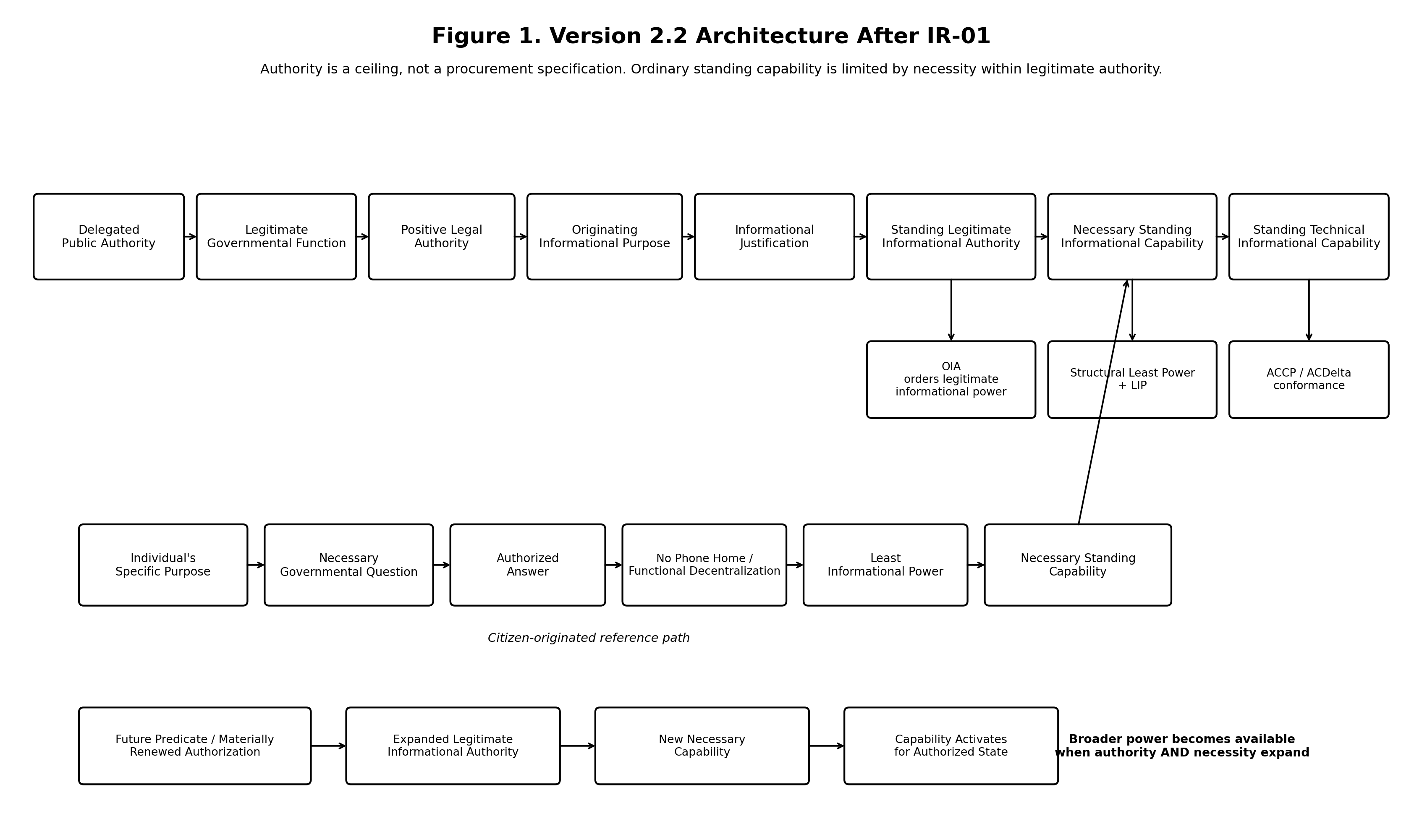
Version 2.2 makes explicit that informational power is not conforming merely because a competent legal source authorizes it. Positive legal authority and legitimate informational authority are distinct, and the correspondence test compares standing technical capability with standing legitimate informational authority. Broader power requires materially renewed authorization.
Two progressions
The standard traces authority along two paths, one from government and one from the citizen:
| Government-originated | Citizen-originated |
|---|---|
| Delegated public authority → legitimate governmental function → originating informational purpose → informational justification → legitimate informational authority → Ordered Informational Authority → Authority-Capability Correspondence → FCGIAS | The individual's specific purpose → the necessary governmental question → the authorized answer → least informational power → legitimate informational authority → corresponding technical capability |
What the standard tests
Requirements cover information domains and originating purposes, purpose particularity, authority identification, purpose sequestration, standing capability, functional golden records, universal search, authorization friction, correlation and inference, AI conformance and provenance, verification before collection, minimum knowledge exposure, intergovernmental and vendor capability laundering, metadata, audit, administrative privilege and break-glass access. A set of structural disqualifiers identifies designs that cannot conform.
Documents
- FCGIAS Version 2.2 Candidate Standard, consolidated controlling editionPDF Word
- Figure 1, Version 2.2 architecturePDF PNG
The standard is presumptively frozen at Version 2.2. Reopening requires a demonstrated material legal defect, architectural contradiction, unaddressed real-world use case, implementation impossibility or conformance ambiguity. Technical critique is welcome at the contact page.