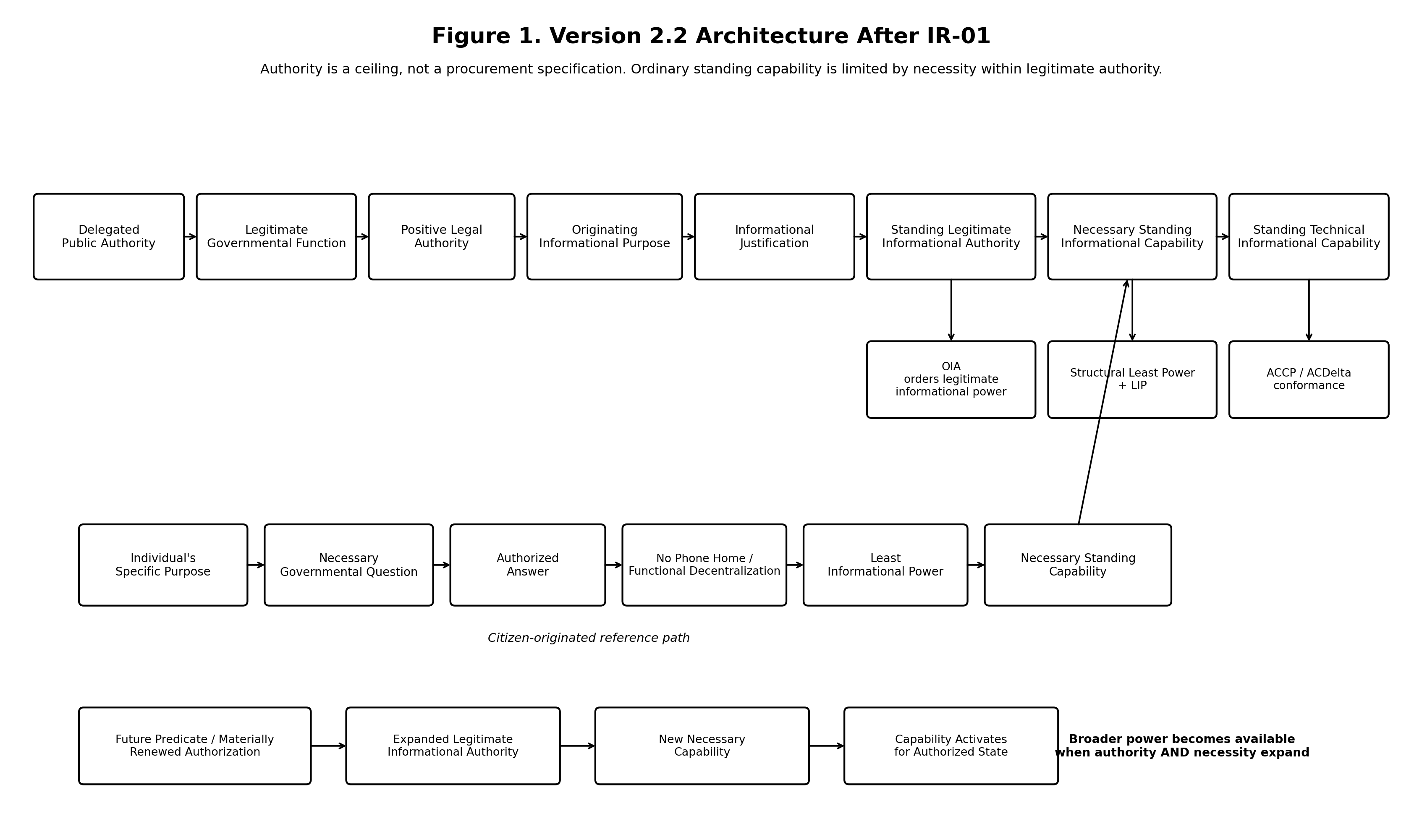
The governing relationship
A system is usually judged by function, cost, security, usability and legal compliance. Fiduciary Commons adds a prior question: what standing power to know will this system give government, and is that power both legitimate and necessary?
STIC ≤ NSIC ≤ SLIA
| Term | Plain meaning |
|---|---|
| Standing Technical Informational Capability (STIC) | What the deployed system can routinely do under ordinary permissions, including administrators, vendors and AI agents. |
| Necessary Standing Informational Capability (NSIC) | What the legitimate function actually needs to be able to do routinely. |
| Standing Legitimate Informational Authority (SLIA) | What government may legitimately do. Legal authority sets this outer ceiling; it does not instruct government to build everything that fits beneath it. |
The Authority-Capability Correspondence Principle tests deployed capability against necessity-bounded authority. Where a less informationally powerful architecture can perform the legitimate function, that is the architecture to build.
Materials
FCGIAS architecture standard
The Fiduciary Commons Government Information Architecture Standard, Version 2.2 Candidate Standard.
Design patterns
No phone-home, authorized answer, query-without-collection, holder-controlled credentials and renewed authority.
Model procurement specification
Procure functions, not generalized informational power. Disclosure, schedules, requirements and evaluation questions.
Conformance test suite
Tests CF-01 through CF-79, assessed against actual capability and evidence rather than policy assertions.